Ali Morshedi is born in Yazd in 1968 (1346). He has got his B. A. and M. A. degrees by the end of the year 1371 (1993) at the University of Imam Sadiq ( A . S . ) and he has now a Ph. D. at the University of Tehran; he has done his research on the issues of Iran; Morshedi Zad has been working in different institutions such as Imam Khomeini ( R . T . A. ) ' s and Islamic Revolution research center; he is a member of the staff at the University of Shahed since a few years ago; he is teaching in different universities. Dr. Morshedi Zad has many works including translation most important of which is "Why the Human Beings Revolt"; his other books are: "from Basij to Revolution, the Government and the Rulers from the Middle Ages of Islam; Comparative Governments, Iran after the Revolution, Government and Social Revolution in Iran; he has also published a book entitled "Turkish Intellectuals and the National and Tribal Identity. This interview has been done by Abbas Moheb Ali on the roots and the reasons for happening of the Islamic Revolution.
The origins of the Islamic revolution of Iran formed and compiled at the time of the Pahlavi regime. Of course it is possible that it had its origins in the Qajar period; the question is that: why the Islamic Revolution of Iran took place in this period? Why did it not happen in the Qajar period although there were a lot of different cases of ethical corruptions and treason? While this is mentioned in some theories of the Revolution; the corruption in the government of the time caused people to revolt and protest. At the time of the Qajar period the corruption of the government was obviously observable and many of these corruptions were prohibited at the time of Pahlavi. Why the revolution did not take place at that time. Wasn't it because of the fighting clergymen or wasn't it because of the way that the Pahlavi regime's authorities ruled the country?
Your question is in fact about the discussion of the whys of the revolution or the explanation of the reasons why the Islamic revolution took place. This has been the concern of many people since the time that the Islamic Revolution took place. Different researchers and scientists both inside and outside the country have dealt with this issue with different approaches.
We can consider four approaches in this regard; one is the sociological approach that investigates the social factors and the society. In this approach the main topic is over the social factors that led to the Islamic revolution.
The other approach is the political approach that investigates the role of the government; in this discussion the main question is: what were the problems of the Pahlavi regime that they were not able to continue their paths and stopped with the revolution.
In addition there are some approaches that deal with economical issues in which the main and the important issue of the discussion is the economical problems of the people at the time of Shah's regime. The economical class, the way to manage the country, the entrance of the money of oil to the internal market, economical growth as well as the increase in the liquidity are some of the problems in this era; in brief the critics deal with the economical problems of the society at those times and speak about the economical problems that cause people to revolt.
The other approach is psychological that investigate the emotional characteristics of the people involved in the revolution as well as the characteristics of the revolutionary leaders and the emotional characteristics of Shah from this point of view that what were the emotional characteristics of Shah that he could not solve the problems when he involved in the revolution.
But your question gives a historical aura to the discussion why Islamic Revolution of Iran took place in the Pahlavi era and did not happen in the period before it? The answer that the scientists give to this question is different as well. Some people say that this not a true question as revolution is like the fruits that have to be ripen and fell from the trees; in other words the revolution is not made rather it happens; that is a series of structural factors collaborates so as the revolution takes place at this time.
Some historians who had a historical point of view came and discussed the socio – political Events during the last 150 years ago and they tried to show the reasons why the Islamic revolution took place. One of these researches is Nicky R. Caddy who investigates the events of the 100 – 150 years of Iran in his book entitled: “The Roots of the Revolution in Iran”?; he discusses the role of the social forces in Iran; he talks about the forces that formed and took part in the political activities; they have been the causes of different events and thereby accelerated the events that led to the revolution.
If we want to consider a special span for studying the history of the Islamic Revolution the best condition is that of the Tobacco movement. The Tobacco movement was a period in which the clergymen came to the scene for the first time; they played their roles and tested themselves. Fortunately they came out of the scene very successfully. The clergymen are set along with the traditional tradesman of the market and the farmers and thereby they removed the foreign domination; from the point of view of the clergymen, the benefits of two groups were in danger in the tobacco contract.
One of these groups was the farmers who had no chance to talk over the prices due to the Tobacco contract; they would change to a mere seller and had to sell their products at a special price; the other group was the tradesmen; as a result of the tobacco contract selling tobacco was exclusively in the hands of the British company and their advantages would soon destroy. Of course the tradesmen had also religious concerns and the clergymen could accord with them and enter the scene and then they created the tobacco movement.
Well, of course this question might come into one’s mind that: why did the clergymen enter the scene at that time and they did not do so before; certainly the root of this issue should be somewhere else?
Yes, it is possible to answer this question in the following way and say it was because of the reform in the Shiite’s Jurisprudence that we observed such changes. The Shiite Jurisprudence is of two branches: The Akhbarion; and the conservatives. The first group omitted the role of the clergymen and they only emphasized on the ayahs and narratives as well as the Hadiths of Prophet Mohammad and in a way there was lack of coherence among them.
But the second group that started to come into being in the Afsharieh period could become more powerful during Qajarieh period. They did believe in the principle of religious sources. Therefore a kind of centrality formed around religious men. This centrality caused a kind of centrality in capital. The economical helps of the Muslims as well as the money they used to send them directly to the religious clerics. Since that time it was not the case that everyone was not giving their quint or their poor – rate to the poor or to the clergyman of their area. In this issue a centrality came into being as a result of which the clergymen finally became powerful economically. According to Shahid Motahhari the Shiite clergymen were anti – cruelty. In the course of the history this characteristic has been extant in the Shiite clergy men; that is to stand against the political powers.
Shahid Motahari in his most valuable article included in the book entitled: “A Discussion on Clergymen and Religious Sources”? that was printed in 60s brought forth this issue that the clergymen fight with cruelty and they have no ties with the political powers. But he also criticizes the Shiite clergy men for their some what commonality; because they get some payments from the people they act in accordance with what they wish for and therefore they are not so much involved in creating change.
Commonality is what Shahid Motahari blames the Shiite clergy men for. Of course he criticizes the Sunni clergy men in other ways. If we consider its powerful point we can say that the Shiite clergymen fight against cruelty and they have had these characteristics during the history. In the end all these elements were allied so that the tobacco movement formed and the clergy men enter the political arena.
When the clergy men enter the political arena another event also took place in the domain of the clergymen’s thought and it was the coming in to being and advent of the scientists, writers and clergy men such as Molla Ahmad Naraaghi and Sheikh Morteza Ansari and other great men such as them who dedicated a great deal of their works to the Jurisdiction discussions.
Molla Ahmad Naraaghi discusses the political issues and Vilayat Faghieh; he says that the jurisprudents are superior to the common people and in this way he for the first time brought forth the discussion of the Shiites clergymen to get hold of the government affairs; if you have a close look at the time before this you would soon understood that the clergymen busied themselves with the religious affairs and theoretically considered government for the innocent Imam at the time of the absence of the Innocent Imam. They used to consider the government as a usurper but in stating that they also used to believe that they have to give this government to the people who have the right to it; they believed that we do not have the right to them as well. It is necessary that Imam Zaman ( A. S. ) should come. But the clergymen came to this decision step by step that it was necessary to form the government for their daily affairs; but if we want to judge we have to have the government to abide by the rights; as a result of this, a revolution took place in the way they used to think.
As you see the clergymen became very important during constitutional government; but the constitutional government was a revolution that was formed on the basis of the Western thought and they have been the cause for the happening of this revolution. These thoughts have been brought in to the country from two different sources: one by those intellectuals who went to Europe such as Malcome Khan and people like him who brought with them liberal thinking. They have become familiar with the Marxist in Caucasus or to Europe and they later on formed and found the Communist party and Toodeh (Mass) Party; if you have a still closer look then you will see that the founders of the Toodeh (Mass) Party were mostly students who became Marxists and created a new social class and was able to include the middle class of the society.
The other one were the workers who had gone to the Caucasus and created the Communist party; therefore the bases of these two parties are different and in fact these thinking methodologies played a great role later on in the creation of Justice – Room and the parliament and later on the establishment of the parliament that created the constitution revolution.
Although the clergymen took part in the constitution revolution but it was omitted from the scene step by step; and some religious men such as the Late Allameh Naeini tried to reconcile religion with democracy but they were not successful. This was ended to the benefit of the intellectual movement in the country and the clergymen could not perform the role that they wanted to play in the constitutional; revolution. . .
The other event that happened after the constitution revolution was coming to power of Reza Shah. The period before coming to power of Reza Shah Iran was experiencing a period of freedom from autocracy; in fact it was a period of democracy. From the point of view of the clergymen and the religious clergymen as well as the people in general the constitutional revolution was a revolution that intended to limit autocracy and create religious government on the basis of the Islamic justice in the society; but Reza Shah’s regime made the two impossible. Even the intellectuals who were working with Reza Shah were step by step disappointed with him; they were either secluded or killed in prison by Reza Shah. People such as Ali Akbar Davar and Taimur Tash as well as those who had an effective role in the formation of Reza Shah’s government were omitted. Of course the religious men and the clergy men have already been omitted. This kind of disappointment led to the coming close of the intellectuals to the clergymen and to follow them. We have to consider the events that took place in the 40s from this point of view.
After Reza Shah went out of power and an open political ambience became dominant. The first point in which the intellectuals are set beside the national forces is the issue of Nationalization of Oil Industry; here Ayat Allah Kashani is placed beside the Late Dr. Mosadegh and together they fulfilled the oil movement. Unfortunately the gaps again occur between these two groups and their social stance until we reach the decade of 60s. The Coup that took place in 1953 and the defeat that worsened the disagreement between the clergymen and the intellectuals created a movement that cause a kind or re – orientation among the intellectuals.
In fact the Intellectuals come to this decision that if we want to create a change in our society we have no way other than clinging to religion and making use of it. It is why in the works of Jalal – e – Al – e – Ahmad we see that he call the intellectual movements westernized and belonging to the west; he says: This force is extremely out of power; it does not have any thing to tell; it is evacuated from within. Jalal – e – Al – e – Ahmad writes his book entitled “Khasi dar Mighat”? in his pilgrimage to Hajj. Seeing the multitude of the Muslims there he says: A movement has to move this force and not only in Iran but also all over the world it has to manage the affairs. It is here that he says that the intellectual does not have the ability to do so; he is unable and his ideas have been taken from the west; it is he who believes that the intellectuals speak a language that can not get in touch with the people.
In fact this thought is created that the intellectual has a strange culture; but it is the clergymen who does this because they are the outcome of the common people. Therefore the idea of hating the westernization and returning to the self is formed in the ideas of late Shariati.
It is interesting that we can see the Asianism topic in the thoughts and ideas of Darius Shaigan and having a native out – look in the thoughts and ideas of Fakhr Al – Din Shadmani and people like him. It is from this time that the points of view of the religious intellectuals are formed. Is it from this time that intellectualism and religiosity bound together?
Yes, certainly. It is here that His Holiness Imam Khomeini ( R . T . A . ) has got the most important force and the greatest number of supporters among the political opposition. Marvin Zunis in a book entitled “the Political geniuses of Iran”?, written in 60s and translated in to Persian, names His Holiness Imam Khomeini ( R . T . A . ) as one of the important opposing forces; he writes I do not think it is impossible that he causes some problems for the Shah’s regime. This shows that they knew His Holiness Imam Khomeini ( R . T . A . ) as a serious political power; because the intellectuals were not so much effective at those times,. The intellectuals who were dependant on the national side have been disappointed with the coup and they were not able to stand against it; they have had ideological problems as well. Their ideological problem was the fact that they did believe in the constitutional law of the constitutional revolution. A person who believed in the constitutional law can believe in reformation and not in revolution and structural as well as serious changes. Therefore there was no hope in them to revolt. If we considered the Toodeh ( Mass ) party and the Writer’s Associations as manifestations of the leftist intellectuals and Marxist groups then the intellectuals would be secluded after the coup and the Marxists would always labeled as foreign agents. The Marxists belonged to the Marxists in Iran and people labeled them as anti – religious groups who rejected religion. The other Marxist groups came out of the Toodeh movements and they co – founded Fadaeian Khalgh organization and they did not believe in the mass movements; the methodology was more based on guerilla fights.
Fadaeian Khalgh believed that they could move ahead with the changes thought armed forces and certainly they did not have the capability to cause the revolution to happen in Iran. Therefore all different movements followed His Holiness Imam Khomeini ( R . T . A . ) and it was the leader of the revolution that was able to coordinate all the forces and move them to conduct the revolution and finally this event took place.
His Holiness Imam Khomeini ( R . T . A . ) did not believe in the armed fights and he always used to say: these movements can damage the regime but do not help the revolution.
Why was His Holiness Imam Khomeini ( R . T . A . ) so sensitive on the subject of the guerilla fights;? We see in every Revolution in the world that the geniuses are terrorized so as to stop the wheel of the revolution and finally the opposing groups come to power. With regard to these things why should not His Holiness Imam Khomeini ( R . T . A . ) disagree with these activities?
The real reason is that His Holiness Imam Khomeini ( R . T . A . ) wanted revolution and not such mere movements; the Iranian society is not the Cuban society and it is not the Nicaragua. In those societies the countries are located in the woods. The Guerilla groups go to the woods and then they attack the cities so as to strike the governmental organizations; may be it is through these ways that they may be able to get control of the cities and thereby they can make a coup or conduct a revolution. The Iranian society does not accept such a method of fighting in any way.
May be His Holiness Imam Khomeini ( R . T . A . ) had the experience of the Jungle Movement and Mirza Koochak Khan . . . . . . . Certainly His Holiness Imam Khomeini ( R . T . A . ) does not accept this method. He used to say these movements are showing off and even it is possible that some innocent men are killed in these movements. We have to come and to move the people; when the mass of the people come in to the streets in millions then the government is handicapped and accordingly the number of the injuries and deaths decreases. In the general movements it is not possible to shoot all the people. It is even possible to get the company of the military soldiers and officers as well. This is the path that His Holiness Imam Khomeini ( R . T . A . ) chose and fulfilled the revolution. This was a historical process of the revolution that I explained. If you want to talk about the political, social and economical as well as emotional aspects then we can open up another discussion.
In the Islamic Revolution of Iran we have to see symbols that have their origins in Ashura. As you have previously mentioned the narratives that are going to be discussed have a brevity natures and have their origins in the spirit of fighting with cruelty among the Muslims and this shows the intelligence of His Holiness Imam Khomeini ( R . T . A . ) . People though they were in Karbala scenes. Yazid of the time, Horr of the time as well as. . . . . . are the examples of the fighting of the right against the wrong. I want to know how it originated and the second issue is the middle class in the 50s and 60s are more afflicted with religion; this means that they were no longer interested in religion. It is after the 60s we see that the late Motahari and the Late Shariati came and with their Islamic orientations attract the middle class and the intellectuals to religion; how much were these events in line with one another? . .
There are two questions here: Why was the concept of martyrdom discussed? And why was it welcomed? Regarding the concept of martyrdom we have to consider two factors/: one is the character of His Holiness Imam Khomeini ( R . T . A . ) and the other is the identity of the Shiite religion. The character of His Holiness Imam Khomeini ( R . T . A . ) is a character that has lived grew with martyrdom. His Holiness Imam Khomeini ( R . T . A . ) ‘s father is martyred when he was only 5 months. Ayat Allah Mostafa Khoemini the father of His Holiness Imam Khomeini ( R . T . A . ) was contemporary to Mirzai – e – Shirazi; he was a religious Jurisprudent. He was killed by the chieftain of the area because he stood against their cruelty. His Holiness Imam Khomeini ( R . T . A . ) is the son of a martyr and has felt martyrdom.
He lost his son in 1977. I have written a note of this for this interview in order to explain His Holiness Imam Khomeini ( R . T . A . )'s point of view regarding martyrdom. His Holiness Imam Khomeini ( R . T . A . ) says after the martyrdom of his son: "These happenings are not important; they took place for all people; they will happen and his holiness God has some mercies bestowed on us. These mercies on the part of God have some important points in them of which we are not aware of because we are incomplete; we can not understand them as we are incomplete from every point of view for example from the point of view of knowledge and action. Therefore we sometimes feel impatience and do not wait; this shows our lack of understanding the nature of what His Holiness God does. If we were aware of the hidden mercies of God to His servants i . e . human beings we would know that He wants the best for us. If we were aware of these issues we would not become so mournful over the issues that are so minute and un – important and then we would understand that there are some benefits and providence at work; that there are things that are working to our benefit.".
His Holiness Imam Khomeini ( R . T . A . )'s interpretation of this situation, which he regards to be very natural and common to all, is very effective. This spirit and this character of His Holiness Imam Khomeini ( R . T . A . ) has been in touch with martyrdom. It is the character of His Holiness Imam Khomeini ( R . T . A . ) that can invite the youths to the arena; very clearly he says: if you want to be successful you have to know that the secret of victory is martyrdom. And if somebody wants to be martyred then what do you want to take from him?"
This spirit was from a characteristic point of view was available in His Holiness Imam Khomeini ( R . T . A . ). Of course the Shiites have had this potential from the past in another way. The Martyrdom of His Holiness Imam Hussein ( A . S . ) has become a symbol and emblem in the Shiite religion.
Although it is possible that at some points in history martyrdom has been interpreted differently and based on the conservative points of view. For example they used to say wrongly about the Christians that cross is for the sake of absolving the sins of the Christians. It is like this point of view in Shiites religion according to which it is said that His Holiness Imam Hussein ( A . S . ) was killed so that the sins of the Shiites are forgiven. But these people say no. His Holiness Imam Hussein ( A . S . ) was killed so as to show the path to us and to teach us this fact: if you want to create reform in society and direct others to do what is laid in law and to enjoin other not to do what is illegal you have to come to the scenes. You have either to kill your enemy or to be killed by your enemy; there is no way in between. If you do not believe in religion at least be liberal people. This is the message of His Holiness Imam Hussein ( A . S . ); these are statements that were available in Shiite religion. The mourning sessions, mosques and Husseinieh were all repeating this message. This means that when the clergymen went to the mosques and talks about the Yazid, His Holiness Imam Hussein ( A . S . ) and people like them and mourns there, then the Muslims and the Shiites who have been sitting at the foot of the altar and they were bringing the scenes to their minds and they used to think that Shah was Yazid; even if the clergymen do not say who is the Yazid of the time, the Shiite wisdom will find it for sure.
Why did people were again inclined towards religion again and more severely and why could martyrdom be discussed in that revolutionary form?
Let's have a comparison between the Constitutional revolution and the Islamic Revolution. The Constitutional revolution was a revolution with western teachings and western ideology in a severe Islamic society. In this society whose bases are mainly traditional they came and created a western revolution.
In the Islamic revolution the traditional education brought forth a return to religion in a society that was moving ahead towards modernity; at those times the society was in a continuous alteration and change; you can compare Tehran at the 60s and 70s from the point of view of cover and the kind of clothes, behavior as well as behavior with one of the European countries. They have discussed many factors for this issue. On the intellectual level a great deal of disappointment was out there with Modernity.
The intellectual of that time was carrying the western thoughts and its beginning was from the Russian intellectuals. When the founders of this thought themselves criticize it then the foundation of this thought will be weak; on the other hand we have to consider the ethnography factor. From the 50s people have started their extensive migration from the villages to the cities and it is increased during the Land Reformation era. This means that the religious crowd came to the big cities and could not simulate the issues.
The villager used to live in his village, go to the mosque and pray in the mosque and he used to talk with his citizens as well as relatives; but he came to a place in which there was nothing like the religion he used to know and most important of all was there a kind of escaping religion. In fact the migrated people were one of the forces that played an important role in the revolution. The comparison of the condition of the non – religiosity of the society and the expectation that they had and then the economical conditions accompanied by the revolution.
In fact the economical factors should not be ignored. It was true that the Islamic Revolution was a religious revolution and religion played the most important role in its fulfillment; there were also some people who have seen the political as aspects as well. They said: we have witnessed the oil shock in the 70s.
The economy of Iran changed very seriously due to great increase in the oil price. There happened the war of Arabs and Israel. The Arab countries boycotted Israel and its supporting countries but Shah's regime did not boycott the Israeli government and increased the sale of oil. These issues led to the increase in the price of oil so as its price reached 50 dollars. Compared with the time that oil was sold at 3 , 4 or 7 dollars a great sum of money entered the Iranian country. In the year 1974 Shah started to import the consumptive goods to the Iranian market.
At those times the economical Marxist discussions, especially the ideas of Marx and the discussion of the classified social revolutions as well as the role of the economy in the formation of the social changes became very hot; the Marxists considered it as the great cause of the Islamic revolution and as a result they divided the country in to poor and rich classes.
Yes, I have to come back to Marx's theory and your question about the theory of Marx. There are two pints of view about if it the poverty is that an element of revolution or if it is the affluence; the third point is the amelioration of these two points; Marx believes that: Poverty causes revolution and the more the poor in a society and the more the gap between different classes of the society the more that society reaches the revolutionary phase. In fact the cause of revolution is the gap between the classes.
In contrast there is another thinker who is named Alexi Du Tukwila who says: "Richness and welfare cause revolution; this means that a person who wants to revolt needs leisure time; he has to have a lot of free time. A person who is wandering in poverty and fortitude and is in search of a piece of bread cannot have any plans for revolution; revolution needs organization it needs time. The poor people do not have the capability to think about these things. With these words he emphasizes that the revolution takes place where there is much welfare.
Two other theorists named Davis and Ger believe that in a fundamental condition the revolution takes place; whenever the welfare and the richness grows in a society the expectations of the people increase accordingly. But in as much as welfare is a material good and economy is a material good; bread, food and car and things as these are material goods and the expectations do not rise for ever. It stops at once and it remains stable or it will have a downfall path and the expectations do rise for ever and thereby it leads to a gap between the expectations as well as the realities of the society.
At the beginning of the Islamic Revolution and with the decrease in the price of oil as well as the decrease in the clash of the Arabs and Israelis the expectation of the people was still high and finally it led to the revolution. This is also considered as one of the effective elements. Let's go back to the discussion of the reasons why people were inclined to religion and discuss the roles that it had on the victory of the Islamic revolution.
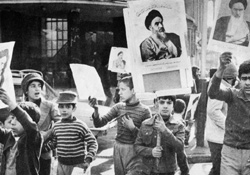
In any way some of the religious forces of the revolution were under the influence of migration to the cities that was the real place where the revolution took place. Some other parts of the religious forces begin their activities and were present in the scenes where the revolutionary ideology was extended. Due to the lack of non – religious ideologies and the fact that the intellectuals could not prevent the religious inclinations of the people, people were more oriented towards religion and even the masses that were not religious before that time were inclined towards religion; for example Hijab was accepted by the Iranian women voluntarily; before the revolution women used not to wear Hijab; to be a sign of resistance as well as to show their involvement with the course of the Islamic revolution wore scarves and dresses while they were taking part in the demonstrations. This shows that the inclination toward religion had increased among the people; non – religious forces and movements also accompanied the Islamic revolution. It is possible to say that some of these were separated from the revolution but it was the revolution that was able to gather all these different forces together and encouraged them to revolt against the government of the time.
After the victory of the revolution there is a two year period which is interpreted by some people as revolutionary silence and some others think this period was the golden time in the history of the revolution. Even the conditions in these two years have drawn the attention of the common people. Especially due to the mercifulness of the people as well as due to the intimate aura that was dominant in the society people were scarifying themselves and everything they had. Even when the distribution of land and property to the poor had started those who had some acres of land did not take any from the government. After the occurrence of the war and the involvement of the country in the war for 8 years a lot of our monetary sources were used up and the country was afflicted with a special poverty. Yet His Holiness Imam Khomeini ( R . T . A . ) called this period the period of disdain so as to keep the unity and coordination of the people. This theory of His Holiness Imam Khomeini ( R . T . A . ) and the sacrificial issues that took place after the revolution and came in to being in the society has become a little discolored. How is it possible to return to the same sacrificial culture that His Holiness Imam Khomeini ( R . T . A . ) used to talk about? We have to think about this issue and see if a society has any meaning without sacrifice and if there was no such sacrificial deeds then would the revolution take place? If there was not the martyrdom seeking of the people and if there was not self – sacrifice of His Holiness Imam Khomeini ( R . T . A . ) then would this revolution take place,? Please tell us a little bit about the events after the revolution for us.
It is not possible to say that self sacrifice and issues as such are always and continuously existent in the society. Even it is not possible to say people do not believe in sacrifice when you do not see sacrifice in the society. Some asked His Holiness Imam Ali ( A . S . ): which one is better justice, forgiving or the sacrifice that you are promoting? He says justice is much better than the others. He is asked why? He says: Justice puts everything in its right position. Forgiving takes the affairs out of their normal course. His holiness says: Justice is a rule but forgiveness is an exception. Therefore the principle is justice. Therefore I want to make use of this Hadith and with regard to what you have said, and you said it quite truly, to say that: self – sacrifice has discolored but sacrifice and self – abnegation is too extensive to be compared. An aspect of self – sacrifice is related to the emotions of the people; when you see a poor and destitute man you sensations and emotions are moved and then you will help them. When you see some one who is suppressed man with cruelty then you will support him. Even if you are destroyed your sensations remain in their right place otherwise your calculating and manual wisdom will tell you to safe keep the money for yourselves instead of helping them.
Sacrifices appear at special times and one of these points is the revolutionary Basij. In as much as the revolutions play a vital role in the revolutions accordingly sacrifices appear there. In a society that has returned to its normal condition, we have no war, no revolution is going to take place and there is not problem; if there are problems they are not so much extreme; they would not find the ground to appear. This does not mean that they can't. This sense of sacrifice is available among all people. It does not know any religious or non – religious men. What it is important is that religion has encouraged people to do sacrifices more. At many different times religion has invited us to help other. If you see a poor man in your beside; although you have the right to your property but it is advisable to help him. Our religion has considered self – sacrifice as a way to solve our social problems.
I believe there is self – sacrifice in our society but it does not have the condition to come to the fore. If people are posited in the conditions similar to those of the revolution the same sacrificial behaviors would appear; of course self sacrifice is a part of our general culture; the Iranians have this spirits but in order to show it self it needs its necessary conditions. Thanks for the time you took.
Source: Quarterly books of Shahed Andishe


